European summers are certainly more variable in weather conditions than they are in the U.S. We woke up early to rain and temperatures in the 40s on July 14th. Nevertheless, I still chose to wear flip-flops to avoid soggy socks and sneakers. Brrr!!
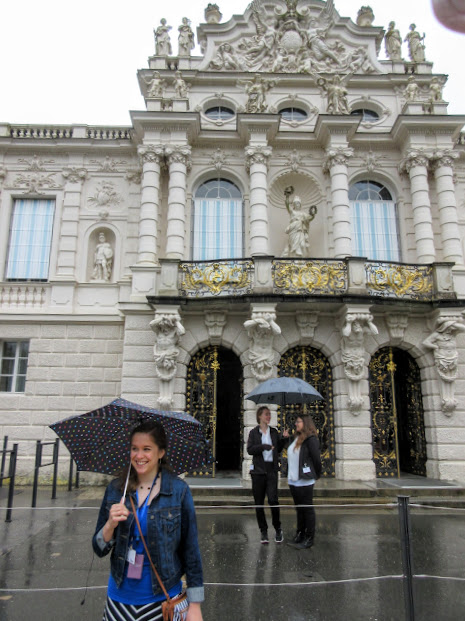
Our first stop on this day was the Linderhof Palace, which was built by "Mad" King Ludwig II of Bavaria. (Some of you may be more familiar with Ludwig's famous Neuschwanstein Castle--take a look at Cinderella's castle, and you'll understand where Disney got his inspiration...). The Linderhof was constructed during the latter half of the 1800s, and it served as Ludwig's hunting grounds and a retreat where the king could fantasize his ideals of absolute monarchy. His story is rather tragic. He was a follower of King Louis XIV of France (also known as the "Sun King"). Similar to Louis XIV, Ludwig II upheld absolute monarchy. However, the Bavarian government remained unreceptive to this position. Consequently, Ludwig built the Linderhof as a refuge, as I mentioned above. He would even imagine himself with other French rulers and actually pretend to converse with them. Eventually, he was pronounced insane and his brother Otto (who had previously inhabited a lunatic asylum) was given the Bavarian throne. (That makes so much sense, doesn't it??) Ludwig was imprisoned for a few days in some remote place which I cannot recall. One day, he and his doctor wandered off into the forest. A few days later, their bodies were found in a lake. To this day, no one knows the cause of their deaths.
When we arrived at the Linderhof, we were struck by the surrounding gardens of the palace. Every so often, the fountain spouts up as a geyser, which adds an elegant effect to the view.
The Linderhof itself was designed with heavy French influences. Its architecture is of the Baroque and Rococo styles. Gold leaf is literally plaited everywhere on the interior. We were not allowed to take pictures indoors, so you'll just have to take my word for it. In my opinion (Elise speaking here), it is glamorous to look at, but it is so flashy that it is nearly gaudy. Never in a million years would I want to inhabit a place with such a heavy dose of "touch-me-not." King Ludwig must not have even liked being seen by the servants because the base of each of his fireplaces was a level below his. He also had a "magic" dinner table that dropped through the floor so the kitchen staff could put his meals on it and send the whole table up.
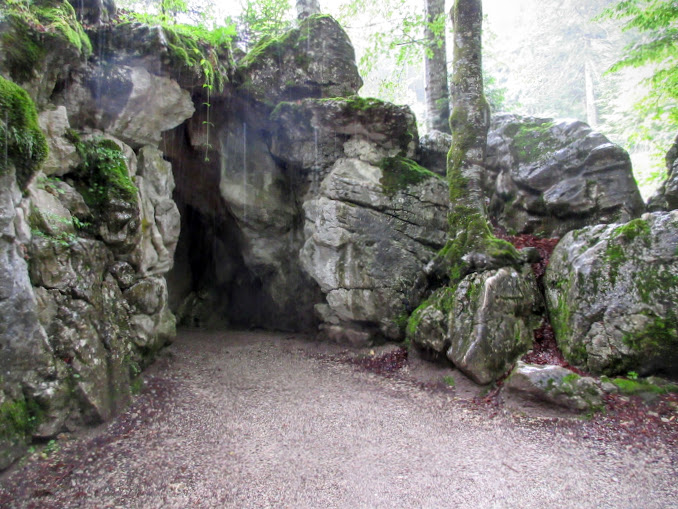
Following our tour of the palace, we walked through the Linderhof grotto, the largest man-made cave in Europe. The composer Richard Wagner used the grotto to perform the first act of "Tannhauser" just for the king.
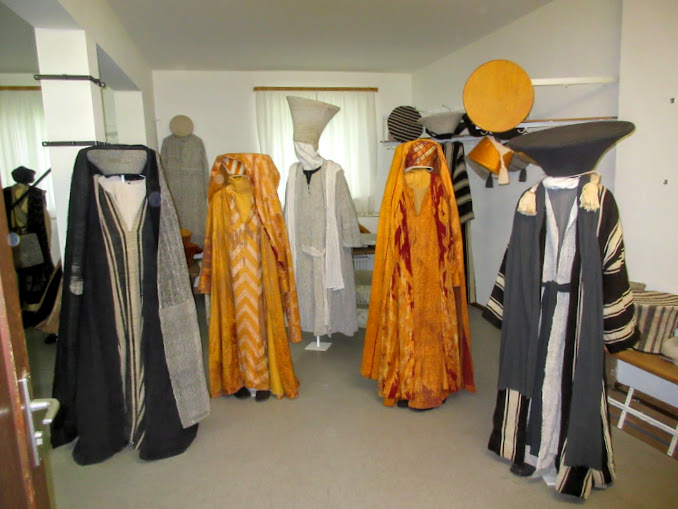
The next location we toured was the Passion Play Theater in Oberammergau. The play has been showcased every 10 years for nearly 400 years. Its history is quite fascinating. In the 1630s, the bubonic plague broke out in the small German town. The residents made an oath to God by promising that if He would remove the plague, they would hold a passion play every 10 years. According to the story, not a single resident died following this promise. Ever since then, the Passion Play has been faithfully upheld (with the exception of two years in which there were wars going on). The next performances will be held in 2020. Although we didn't see the play, we did get to go behind the scenes. Not only did we see video clips and photographs of the play, we also got to view the stage and many of the costumes and props. Only native inhabitants of Oberammergau (or those who have lived in the town for at least 20 years) may be actors in the play. The year before performances, all participating men must grow out their hair and beards. Artificial hair is never used. Sadly, in a video interview with an actor who played Jesus, the young man seemed to think Jesus was crucified merely for his challenging ideas. In addition to this, there seemed to be more attention paid to the actual crucifixion than to Jesus' death AND resurrection.

The stage
Costumes of the Pharisees
Oberammergau is also known for its extraordinary wood carvings. We saw many examples at our hotel, various souvenir shops, and museums. My favorite carving is the one in the photo directly below. It is a crucifix on one of the Alpine cliffs surrounding the village. What a comfort it was to look up at that cliff from almost anywhere in the village and see a physical reminder of Jesus' saving gift to us in His death and resurrection!
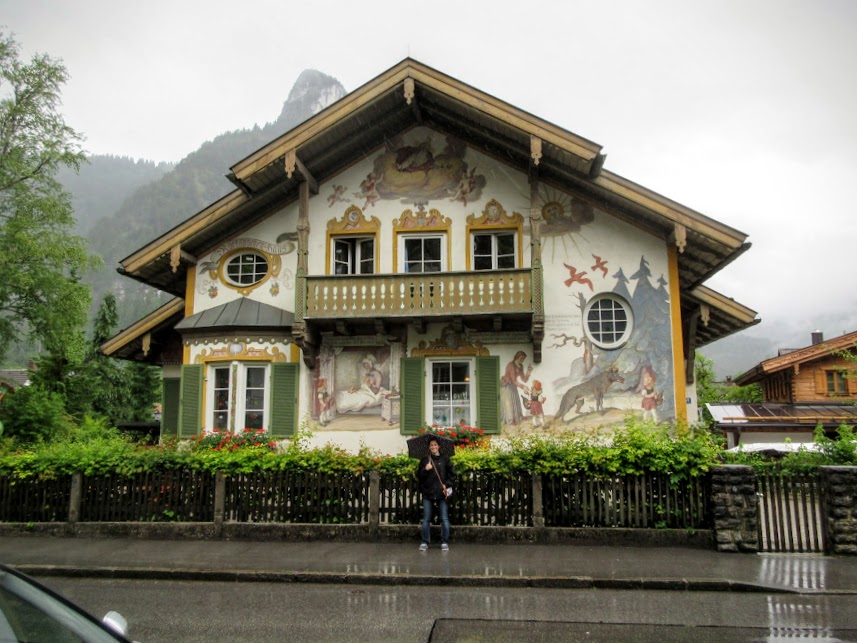
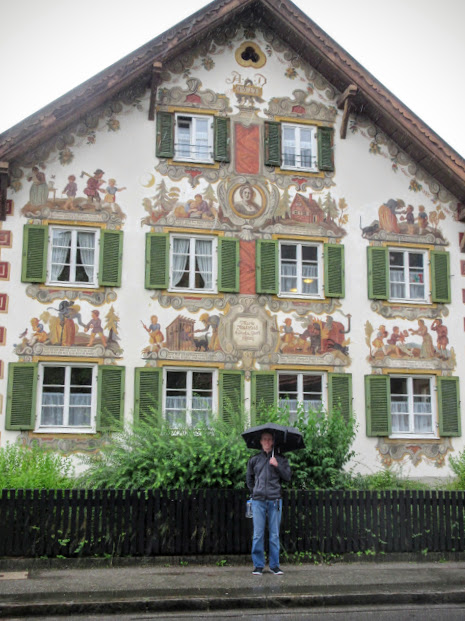
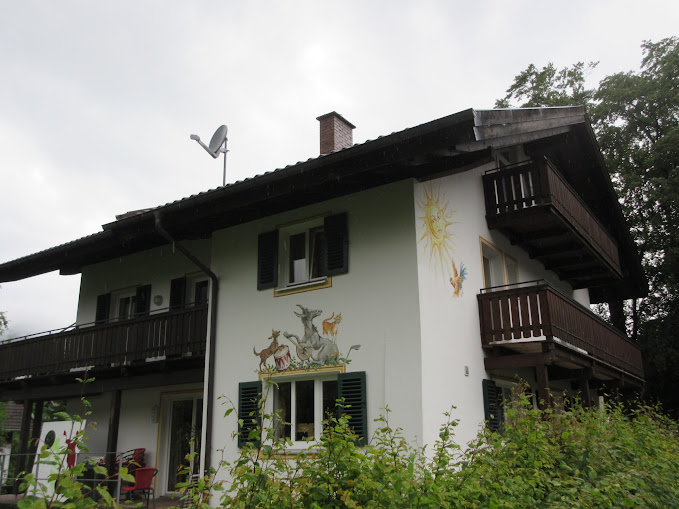
We had the rest of the afternoon to do whatever we pleased. David and I wandered around Oberammergau in the rain, snapping photos of some of the quaint buildings which depict fairy tales. Here they are!
Little Red Riding Hood
Hansel and Gretel
The Bremen Town Musicians