Saturday, November 5, 2016

Explorations in Eisenach

July 17, 2016

We took a day-trip to Eisenach in order to experience two monuments of importance regarding Lutheran history:
  1. The Wartburg Castle
  2. The Bach House Museum
I'll begin with the former, which was first on our agenda.


The Wartburg was built in the 1100s by Frederik "the Jumper." Thuringian forest surrounds the castle on all sides. Legend has it that this massive stronghold received its name due to Frederik's statement upon seeing the site for the first time. He supposedly proclaimed, "Mountain, I will make a castle out of you one day." 

Mountain = warte

Burg = castle.

There you have it.

The Wartburg was not only the place where Martin Luther translated the New Testament into German, but it was also the residence of St. Elizabeth of Hungary. At the age of 14, she married Louis IV. She developed such a great sympathy and love for the poor that she would go so far as to smuggle food out of the castle for them. Her mother-in-law thought ill of this and tried to catch her in the act. When Elizabeth removed her cloak, it is said that the bread underneath immediately turned into roses. Thus, artwork often depicts her with roses to this day. After becoming a widow (her husband died in a crusade), Elizabeth left the castle to serve the poor. Tragically, she worked herself to death at the premature age of 24. Within the Wartburg, a room of mosaics is dedicated to her life with over 7 million pieces of glass. 

Around 300 years later, Martin Luther inhabited this fortress. We also viewed a reconstruction of the room in which Martin Luther stayed as he wrote his German translation of the New Testament. One of the artifacts in this room is a whale vertebrae, which Luther may have used as a footstool.


Following the Wartburg tour, we wandered the streets of little Eisenach and ventured into St. George's Church, where we heard someone preparing for an organ recital. It was at this church that J.S. Bach was baptized and Luther sang as a choirboy.


Notice the "Ein Feste Burg Is Unser Gott" inscription... :)


The next part of our day-trip was the Bach House. Bach, next to Martin & Katie Luther, is one of my heroes. I greatly admired the composer's determination in spite of various obstacles throughout his life. At one point, he was even thrown in jail for "Obstinacy." Nevertheless, he continued to compose music in his own style. He was never considered a great composer in his lifetime or even directly after his death. It was not until Felix Mendelssohn resurrected and assisted in performing Bach's music over 100 years later that people began to recognize him for who he truly was: a genius composer of over 1,000 musical compositions.


Though the photo is blurry, Bach's orgiinal signature can be found somewhere on these pages.

Soli Deo gloria--To God Alone be glory!


Sunday, September 25, 2016

Erfurt Excursions

Following our brisk tour of the Schloss Coburg, we made our way to Erfurt--one of the first cities we visited that was once part of East Germany. As we later found out on the tour, it survived the Second World War without very much bomb damage. Although there was definitely more graffiti and a slightly rougher vibe to the city compared to others, it quickly won me over due to its eclectic architectural styles, history, and (of course!) pipe organs.

Our official tour of the city began on the morning of July 16th. We gathered around the Luther statue in front of the Merchant Church...where we would later return for an evening service.

Our first stop was the monastery where Luther became a monk. Supposedly, the scholar stood before the entrance to the monastery and told his friends, "After this, you will see me no more." Little did he know how much he would influence history and the church as we know it today!


We learned some interesting tidbits regarding Erfurt's history while on the walking tour.

  • It was founded by St. Boniface in the 11th century. 
  • Its most profitable trade was woad, a blue dye which was later replaced by Indian indigo (after the Eastern trade routes expanded).
  • It is known as the "Rome of Germany" because there are so many churches there. 
  • The original city walls still exist on one side. 
  • The city as a whole now features just about any flavor of architectural style: Romanesque, Gothic, Baroque, Rococo, Art Deco, you name it!


It was a lovely day to meander the streets. We walked over the Kramerbrucke, a bridge which dates back to the Middle Ages.


The walking tour at the steps of two cathedrals overlooking the market square. On the right, you have the St. Severus Church (Romanesque style), and on the left, you have Erfurt Cathedral (Gothic). After a group photo, we ventured up the steps and into the cathedral.


Words can't express the beauty of this place.

David and I then trekked up to the Erfurt wall to behold a breathtaking view of the city. I counted at least 21 church spires, though I know I probably missed several!


 St. Severus & Erfurt Cathedral (view from the Erfurt wall)


After climbing back down, my memorable 21st birthday adventure began! We had a lovely luncheon treat at a local cafe. We shared a cheesecake slice with dark chocolate crumbles (and I had coffee).


At 6:00, we went back to the Merchant's Church for a prayer and organ service. Unfortunately, the old organ no longer plays, so the organist played an electronic organ. Following the service, I got to play the organ! Granted, it wasn't a big, historic pipe organ, but it was still a great honor to get to play in a location of such significance. Not only did Martin Luther preach here, but J.S. Bach's parents were also married at this church. The following link features what I played: chorale prelude "Komm Heileger Geist, Herre Gott" by Dietrich Buxtehude.
As always, if you are interested, do visit our map to see more photos from this beautiful city!

Saturday, August 20, 2016

Coburg Castle...and more!

We left Oberammergau early on July 15th in order to arrive in Erfurt on schedule. This was our longest "bus day" for the entire trip. As we traded the Alps for the rolling Thuringian farmlands, I realized what an impression the mountains had left on me. I found myself missing the misty peaks, the forest greenery, and the fairy-tale village of Oberammergau. However, we were both thrilled to finally begin to see historic Martin Luther sites.

On our way to Erfurt, we passed through Nuremberg, where the famous trials following the Second World War took place. We arrived in Coburg for a brief lunch break before visiting Veste Coburg (Coburg Fortress).We dined at a charming 400-year-old restaurant, where we shared a Coburger (a 10-inch sausage) and a lager. Then, we briskly walked the streets of Coburg in search of a church where Martin Luther preached. We found it...barely!


Stadkirche St. Moriz (where Luther preached)

Time was running short, but I really wanted to see the organ (even though I'd already seen at least 6 by this point)...

After David dragged me out of the church, we went to the Veste Coburg, where Martin Luther stayed in 1530 during the Diet of Augsburg. During his stay, he worked on his translation of the Book of Ezekiel. He also complained that Coburg wine was too sour. As it turns out, it was later discovered that the climate was too cold for grape cultivation, so wine is no longer produced in this city.


It would have taken at least a full day to see everything in the castle, but we hadn't the time for that because we needed to arrive in Erfurt before dinnertime. Below are some pictures of the major highlights of the castle.

Portraits of the Luthers--from the Cranach workshop

Ceiling detail from one of the rooms in the fortress
Rather than being carved, much of the wood was puzzle-pieced together!

Medieval Armor


Waving goodbye to Veste Coburg!

Saturday, August 13, 2016

An Excursion in the Park


We came across a children's park in Oberammergau...and found ourselves having a bit too much fun. Not only did we encounter a man-eating dragon, but we also whizzed around on a little zipline. Enjoy the videos!


Saturday, August 6, 2016

Our Day in Oberammergau

European summers are certainly more variable in weather conditions than they are in the U.S. We woke up early to rain and temperatures in the 40s on July 14th. Nevertheless, I still chose to wear flip-flops to avoid soggy socks and sneakers. Brrr!!

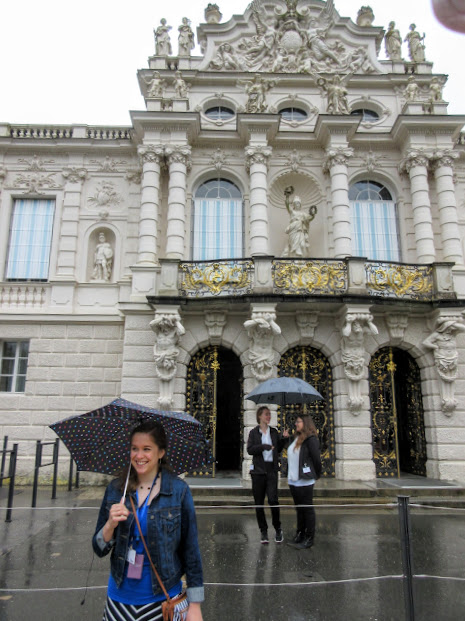
Our first stop on this day was the Linderhof Palace, which was built by "Mad" King Ludwig II of Bavaria. (Some of you may be more familiar with Ludwig's famous Neuschwanstein Castle--take a look at Cinderella's castle, and you'll understand where Disney got his inspiration...). The Linderhof was constructed during the latter half of the 1800s, and it served as Ludwig's hunting grounds and a retreat where the king could fantasize his ideals of absolute monarchy. His story is rather tragic. He was a follower of King Louis XIV of France (also known as the "Sun King"). Similar to Louis XIV, Ludwig II upheld absolute monarchy. However, the Bavarian government remained unreceptive to this position. Consequently, Ludwig built the Linderhof as a refuge, as I mentioned above. He would even imagine himself with other French rulers and actually pretend to converse with them. Eventually, he was pronounced insane and his brother Otto (who had previously inhabited a lunatic asylum) was given the Bavarian throne. (That makes so much sense, doesn't it??) Ludwig was imprisoned for a few days in some remote place which I cannot recall. One day, he and his doctor wandered off into the forest. A few days later, their bodies were found in a lake. To this day, no one knows the cause of their deaths.

When we arrived at the Linderhof, we were struck by the surrounding gardens of the palace. Every so often, the fountain spouts up as a geyser, which adds an elegant effect to the view.


The Linderhof itself was designed with heavy French influences. Its architecture is of the Baroque and Rococo styles. Gold leaf is literally plaited everywhere on the interior. We were not allowed to take pictures indoors, so you'll just have to take my word for it. In my opinion (Elise speaking here), it is glamorous to look at, but it is so flashy that it is nearly gaudy. Never in a million years would I want to inhabit a place with such a heavy dose of "touch-me-not." King Ludwig must not have even liked being seen by the servants because the base of each of his fireplaces was a level below his. He also had a "magic" dinner table that dropped through the floor so the kitchen staff could put his meals on it and send the whole table up.

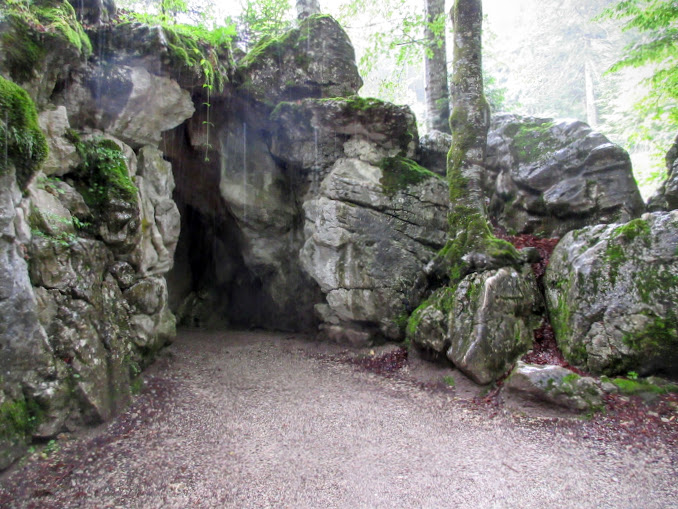
Following our tour of the palace, we walked through the Linderhof grotto, the largest man-made cave in Europe. The composer Richard Wagner used the grotto to perform the first act of "Tannhauser" just for the king.

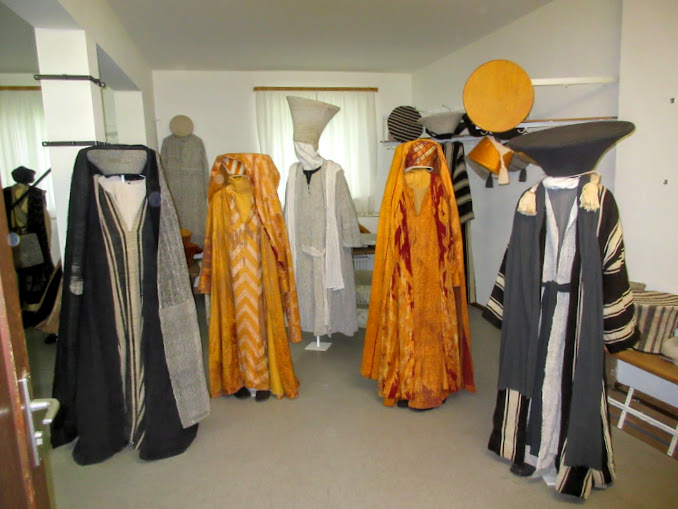
The next location we toured was the Passion Play Theater in Oberammergau. The play has been showcased every 10 years for nearly 400 years. Its history is quite fascinating. In the 1630s, the bubonic plague broke out in the small German town. The residents made an oath to God by promising that if He would remove the plague, they would hold a passion play every 10 years. According to the story, not a single resident died following this promise. Ever since then, the Passion Play has been faithfully upheld (with the exception of two years in which there were wars going on). The next performances will be held in 2020. Although we didn't see the play, we did get to go behind the scenes. Not only did we see video clips and photographs of the play, we also got to view the stage and many of the costumes and props. Only native inhabitants of Oberammergau (or those who have lived in the town for at least 20 years) may be actors in the play. The year before performances, all participating men must grow out their hair and beards. Artificial hair is never used. Sadly, in a video interview with an actor who played Jesus, the young man seemed to think Jesus was crucified merely for his challenging ideas. In addition to this, there seemed to be more attention paid to the actual crucifixion than to Jesus' death AND resurrection.

The  stage

Costumes of the Pharisees

Oberammergau is also known for its extraordinary wood carvings. We saw many examples at our hotel, various souvenir shops, and museums. My favorite carving is the one in the photo directly below. It is a crucifix on one of the Alpine cliffs surrounding the village. What a comfort it was to look up at that cliff from almost anywhere in the village and see a physical reminder of Jesus' saving gift to us in His death and resurrection!


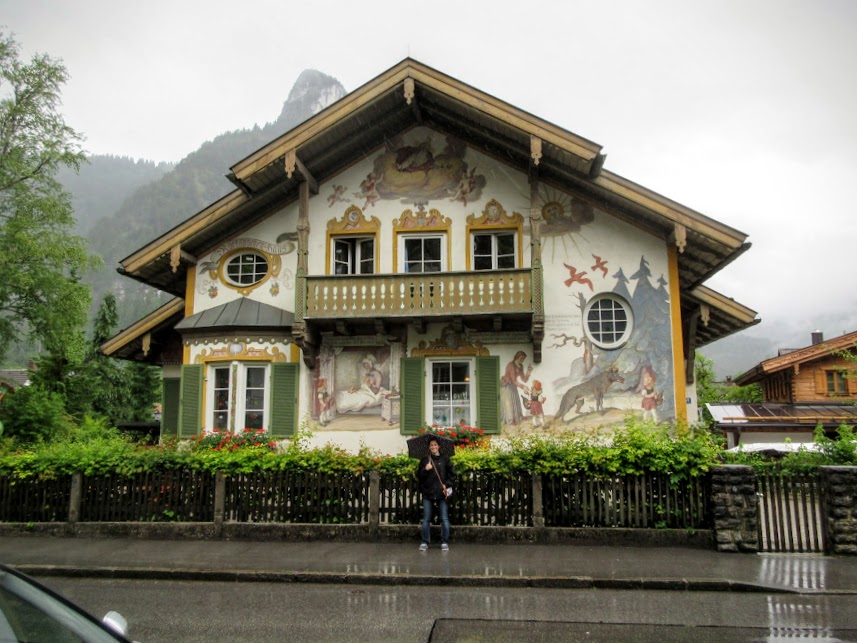
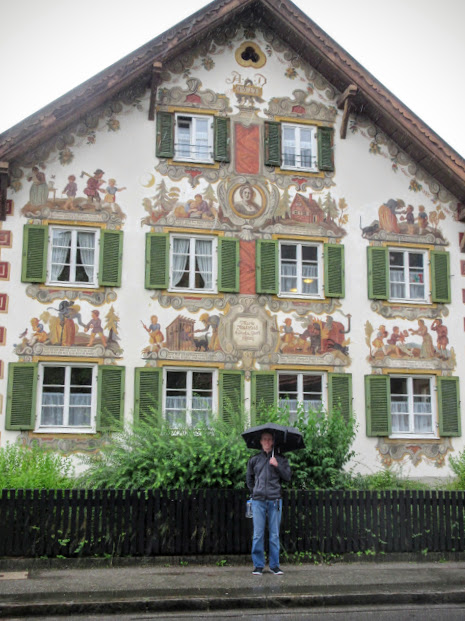
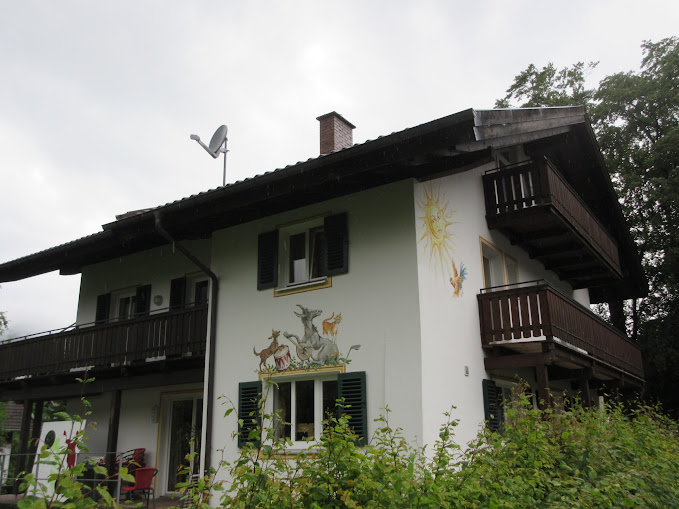
We had the rest of the afternoon to do whatever we pleased. David and I wandered around Oberammergau in the rain, snapping photos of some of the quaint buildings which depict fairy tales. Here they are!

Little Red Riding Hood


Hansel and Gretel

The Bremen Town Musicians


Friday, July 29, 2016

Adventures in Innsbruck

On July 13th, we turned in our extremely heavy room keys at the Hotel Mozart and departed for a quite rainy Innsbruck, which means "The River Bridge." According to Dr. Maier, the town is connected to the LSB hymn "Now Rest Beneath Night's Shadow." Martin Luther named the tune "Innsbruck" with the town in mind. On one occasion, he traveled through Innsbruck on his way to Rome when he was a monk.

The first landmark we saw on the walking tour was the Goldenes Dachl (Golden Roof). Holy Roman Emperor Maximilian I had it constructed in honor of his second marriage to Bianca of Italy. It was built with over 2,000 copper tiles painted over with gold. The wall beneath the roof actually features both of his wives (his first wife Mary had died in a hunting accident). Maximilian and Bianca are featured in conversation with one another, while the first wife is seen looking over Bianca's shoulder. Can you say, "Awkward?"!

My handsome hubby in front of the Golden Roof

Emperor Maximilian I had his body buried in the Hofkirche, the nave of which is surrounded by 28 larger-than-life bronze statues. Apparently, Albrecht Durer created a few.

Memorial to Maximilian I, Holy Roman Emperor from 1493-1519


In our free time, we also went to the Innsbruck Folk Museum, which features many wooden artifacts from everyday Alpine life. There are even rooms with wood paneling and furniture from real-life German homes!

Our final stop was to the Cathedral Saint Jakob (Saint James Cathedral), which is an important landmark on the St. James Pilgrimage. The path connects Spain to the Holy Land.  The views of the altar, pipe organ, and ceilings were absolutely breathtaking. For more pictures from any of the sites discussed above, please visit our map and click on "Innsbruck."

Cathedral St. Jakob